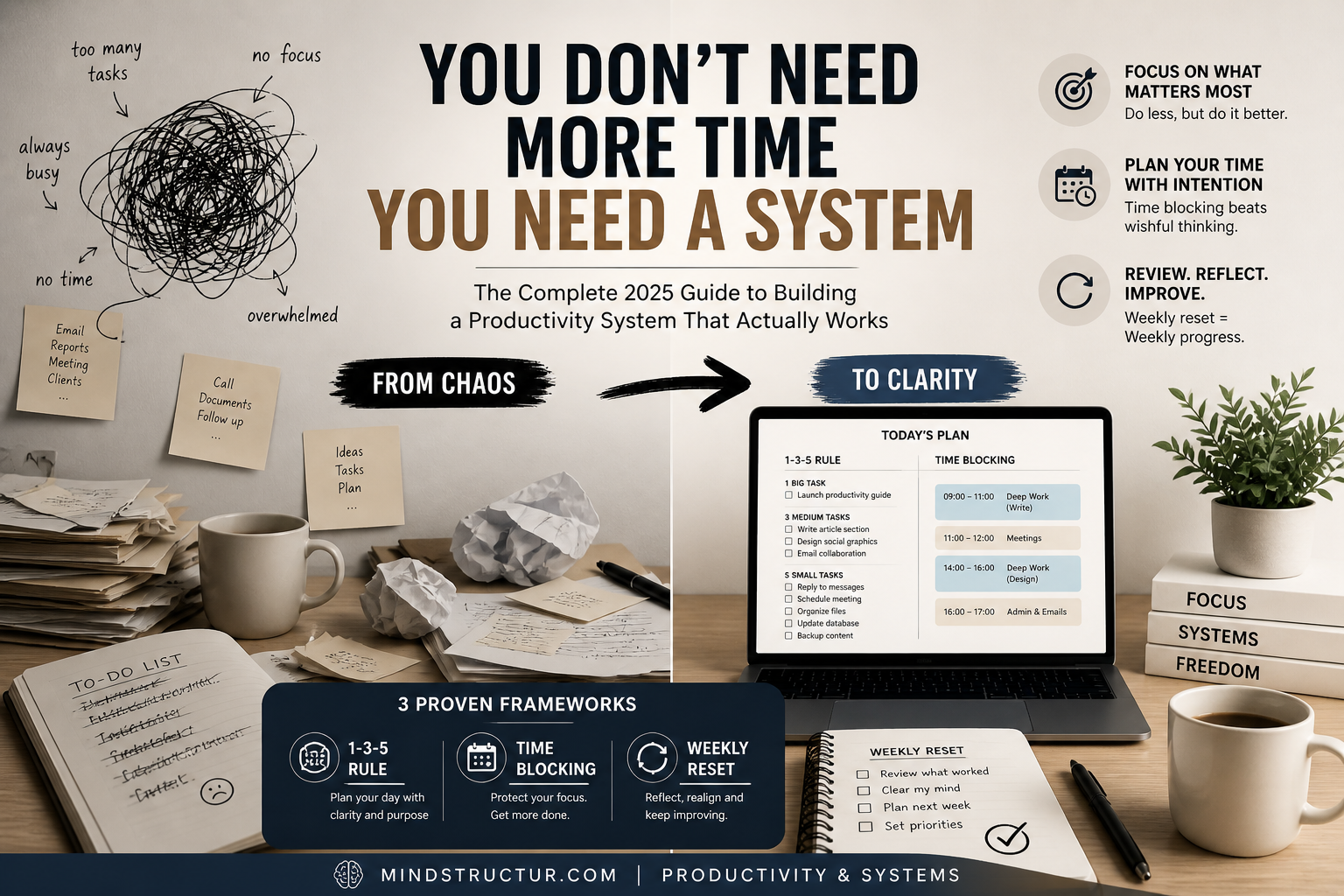
You Don’t Need More Time — You Need a System
1. The Real Reason You’re Always Running Behind
If you’ve ever ended a full day of work feeling like you accomplished nothing meaningful — you’re not alone, and you’re not the problem. The real issue isn’t how many hours are in your day. It’s the absence of a system that tells your brain exactly what to focus on, and when.
Most people manage their day reactively. They open their inbox, respond to whoever shouted loudest, jump between tasks when something else pops into their head, and repeat — until 6 PM arrives and they realize the most important work never got done.
| 41% of to-do items are never completed iDoneThis, 2023 | 2.1h lost daily to task-switching overhead American Psychological Association |
The solution isn’t discipline, willpower, or waking up at 5 AM. The solution is a system — a repeatable structure that removes daily decision fatigue and ensures your most important work happens first, every single day.
| Key Insight Productivity is not about doing more. It is about doing the right things, in the right order, with the right amount of focus. A system creates the conditions for that to happen automatically. |
2. What a Productivity System Actually Is
A productivity system is a set of repeatable routines and rules that govern how you capture tasks, decide what to work on, and review your progress over time. The keyword is repeatable a good system runs almost on autopilot, so you spend zero mental energy deciding how to manage your day.
Every effective productivity system has three core components:
Component 1 — Capture
A single, trusted place where every task, idea, and obligation lands. This can be a notebook, a notes app, or a task manager — what matters is that it’s one place, not seven. The moment you try to hold tasks in your head, your working memory is hijacked and your focus collapses.
Component 2 — Prioritize
A daily ritual usually taking two to five minutes where you review what’s in your capture system and decide what today’s non-negotiable work is. Without this step, urgency always beats importance. You stay busy but rarely make meaningful progress.
Component 3 — Review
A weekly session of 20 to 30 minutes where you zoom out, clear the backlog, reflect on what worked, and set the next week’s direction. This is the most overlooked step in productivity — and the one that separates people who drift from people who compound.
| “A system is not a rigid cage. It is a scaffold that gives your energy somewhere useful to go.” MindStructur Editorial |
3. The Science: Why Your Brain Needs Structure
Neuroscience is clear on this: the prefrontal cortex the part of your brain responsible for planning, decision-making, and focus has a finite daily capacity. Every unresolved task, every interruption, every open loop in your mind draws from that capacity.
Psychologist Roy Baumeister’s research on ego depletion showed that the more decisions we make, the worse the quality of later decisions becomes. This is not a character flaw it is biology. The brain is an energy-rationing organ, and decision fatigue is one of its primary protection mechanisms.
| 35,000 decisions the average adult makes per day Cornell University, Wansink & Sobal | 23 min to regain focus after a single distraction UC Irvine, Gloria Mark |
A well-designed productivity system offloads this cognitive overhead. Instead of deciding what to do next (a decision that drains mental resources), your system tells you. The brain is freed to do what it does best: creative thinking, problem solving, deep analysis.
The practical result: people who use structured daily planning systems report significantly higher levels of focus, lower end-of-day mental fatigue, and greater satisfaction with the quality of their output not because they worked harder, but because they worked in alignment with how their brain actually operates.
4. Framework #1 The 1-3-5 Daily Rule
The 1-3-5 Rule is the simplest daily planning framework in existence, and one of the most effective. Every morning, before checking email or opening any app, you plan your day using a fixed structure:
- 1 Big Task — the single most important thing you need to accomplish today. This is the work that, if done, makes today a success regardless of what else happens. Schedule it during your peak energy hours.
- 3 Medium Tasks — important work that supports your goals or keeps projects moving. These typically take 20 to 45 minutes each and require genuine focus.
- 5 Small Tasks — quick actions under 15 minutes. Emails to send, calls to make, documents to file. These fill gaps between deep work blocks.
The power of 1-3-5 is constraint. You cannot put 30 items on your list. You are forced to choose — which means you are forced to think about what actually matters. That two-minute morning planning session is one of the highest-leverage activities in your entire day.
| How to Start Tomorrow Before you sleep tonight, write down your 1-3-5 for tomorrow. Place it on your desk or as your phone wallpaper. When you wake up, your priorities are already decided. No willpower required — just execution. |
5. Framework #2 — Time Blocking
Time blocking is the practice of assigning specific tasks to specific time slots in your calendar, rather than working from a free-floating to-do list. Instead of asking ‘what should I do next?’, you look at your calendar and you simply execute what’s already been decided.
Research by Cal Newport, author of Deep Work, demonstrates that uninterrupted focus blocks of 90 minutes or more produce disproportionately better output than fragmented work sessions of equivalent total time. The reason is simple: deep cognitive work requires a ramp-up period of 15 to 20 minutes before full focus is reached. Interruptions reset that clock completely.
A Sample Time-Blocked Day
| Time | Block Type | Activity |
| 8:00 – 10:00 AM | Deep Work | Your #1 task — highest cognitive demand, zero interruptions |
| 10:00 – 10:30 AM | Admin | Emails, messages, quick replies |
| 10:30 – 11:00 AM | Recovery | Walk, stretch, or light reading |
| 11:00 AM – 1:00 PM | Deep Work | Second focus block — project work or creative tasks |
| 1:00 – 2:00 PM | Rest | Lunch away from the desk |
| 2:00 – 3:00 PM | Meetings | Batch all calls and meetings here |
| 3:00 – 5:00 PM | Deep Work | Final focus block — wrap and review |
Notice that meetings are batched into one window. This is intentional. Every meeting that fragments a morning of deep work costs far more than its scheduled duration — it destroys the focus context you spent 20 minutes building.
6. Framework #3 — The Weekly Reset
The weekly reset is the glue that holds your productivity system together. Without it, small inefficiencies compound, unfinished tasks pile up, and your system gradually drifts into chaos. With it, every week starts clean, intentional, and aligned with what actually matters.
Schedule 20 to 30 minutes every Sunday evening — or Friday afternoon if you prefer a clean separation between work and weekend. The review follows a consistent sequence:
- Clear your capture system. Process every item: delete, delegate, schedule, or complete.
- Review last week. What did you finish? What didn’t happen and why? What do you want to do differently?
- Check your calendar. What fixed commitments exist next week? Where are your available deep work windows?
- Set your Top 3 goals for the week. Not 10. Not 5. Three meaningful outcomes that matter.
- Pre-load Monday. Write tomorrow’s 1-3-5 before you close the laptop. Walk in with a plan.
This ritual takes less time than one low-quality meeting, and it returns more value than almost any other single activity in your productivity stack.
| “The weekly review is not a productivity trick. It is how strategic thinkers stay strategic — by refusing to let the urgent permanently displace the important.” — Cal Newport, Deep Work |
7. How to Build Your System in 30 Minutes
You don’t need expensive tools, complex apps, or a weekend retreat to build a productivity system. Here is a complete, actionable setup in four steps that takes 30 minutes total:
Step 1 — Choose your capture tool (5 minutes)
Pick one trusted inbox. Options: a dedicated notebook, Apple Notes, Notion, Obsidian, or a simple text file. The tool matters far less than the habit of using it exclusively and consistently. Write down your choice now.
Step 2 — Set up your daily planning ritual (5 minutes)
Decide when you will plan your day — morning is ideal, but the night before also works. Set a recurring calendar reminder titled ‘1-3-5 Planning — 2 minutes’. Keep a notebook or note open with yesterday’s leftovers visible. The ritual takes under three minutes once it becomes habit.
Step 3 — Block your time (10 minutes)
Open your calendar and create three recurring events for next week: one 90-minute morning deep work block (non-negotiable), one admin window, and one meeting slot. Color code them. Treat deep work blocks as immovable appointments with yourself.
Step 4 — Schedule your weekly reset (10 minutes)
Create a recurring 30-minute calendar event every Sunday at 8 PM (or your preferred time). Title it ‘Weekly Reset’. In the description, paste the five-step review sequence from Section 6. You now have a system. Everything from this point forward is iteration and refinement.
| 30-Day Challenge Run this system without modification for 30 days before evaluating or changing anything. Most people abandon productive systems too early — not because they don’t work, but because they haven’t given them time to compound. Commit to the 30 days. |
8. The 5 Most Common Mistakes — And How to Fix Them
After working with thousands of readers and studying hundreds of productivity case studies, the MindStructur team has identified five mistakes that account for the vast majority of system failures. Knowing them in advance is the fastest way to avoid them.
Mistake 1 — Planning too many priorities
Fix: Apply the 1-3-5 constraint ruthlessly. If everything is important, nothing is. Ask yourself: if I could only finish one thing today, what would it be? That is your Big Task. Everything else is support.
Mistake 2 — Letting meetings invade deep work windows
Fix: Defend your morning. Block 8 to 11 AM as a no-meeting zone in your calendar. Communicate this to your team. The most cognitively demanding work should happen during your peak hours — not during the small gaps between calls.
Mistake 3 — Skipping the weekly reset
Fix: Treat it as a non-negotiable appointment. It takes 25 minutes. Missing it means your system gradually decays until the following Monday feels like you’re starting from scratch.
Mistake 4 — Building a perfect system before using any system
Fix: Start with the minimum viable version today. A 1-3-5 list on a Post-it note is infinitely more effective than a perfectly architected Notion dashboard you haven’t used yet. Build, then refine.
Mistake 5 — Measuring inputs instead of outputs
Fix: Stop tracking hours worked and start tracking outcomes completed. Did you finish your Big Task today? That is a productive day. Did you work 12 hours but never touch your #1 priority? That is a productivity failure regardless of the hours.
9. Frequently Asked Questions
Q: What’s the best app to use for this system?
A: The app that you will actually use consistently. Notion, Todoist, Apple Reminders, and a physical notebook all work equally well. The system is more important than the tool. Start with whatever you already have.
Q: How long before I see results?
A: Most people notice a significant difference in clarity and daily output within five to seven days of consistent use. The compounding benefits — reduced anxiety, improved focus, better work quality — become fully apparent around the 30-day mark.
Q: What if my job is unpredictable and urgent tasks always come up?
A: Build a buffer. Instead of time blocking 100% of your day, protect 60% with intentional blocks and leave 40% unscheduled for reactive work. Your Big Task still gets done in the morning; the rest of the day handles the unexpected.
Q: Should I use the same system on weekends?
A: A lighter version, yes. Keep the capture habit — write down anything that comes to mind. But weekend planning should focus on rest, recovery, and personal goals rather than professional output. Balance is itself a productivity strategy.
Q: I’ve tried systems before and they always fail. Why would this be different?
A: Because this article focuses on behavior design, not willpower. Every framework here is built around reducing friction and cognitive load — the two primary reasons systems fail. Start small, stay consistent for 30 days, and build from there.
10. Key Takeaways & Next Steps
If you take only three things from this article, let them be these:
- Time is not your problem. The absence of a system that manages your attention is your problem. Every framework in this article addresses that root cause directly.
- Start smaller than you think you should. A two-minute 1-3-5 list every morning is a complete system. Build from there only when the habit is solid.
- Review weekly without exception. The weekly reset is where the real leverage lives — it compounds every other habit in your system.
Your next step is not to read another article. It is to implement one thing from this guide today. Right now, before you close this document:
- Open your calendar. Block 90 minutes tomorrow morning as ‘Deep Work — Do Not Schedule’.
- Write your 1-3-5 for tomorrow. One big task. Three medium. Five small.
- Set a recurring Sunday reminder for your Weekly Reset.
That is all. Those three actions take under 10 minutes and they are the beginning of a system that, if maintained, will fundamentally change the quality of your working life.
| Save This Article Share it with someone who needs a better system. Find more guides, templates, and tools at: MINDSTRUCTUR.COM |