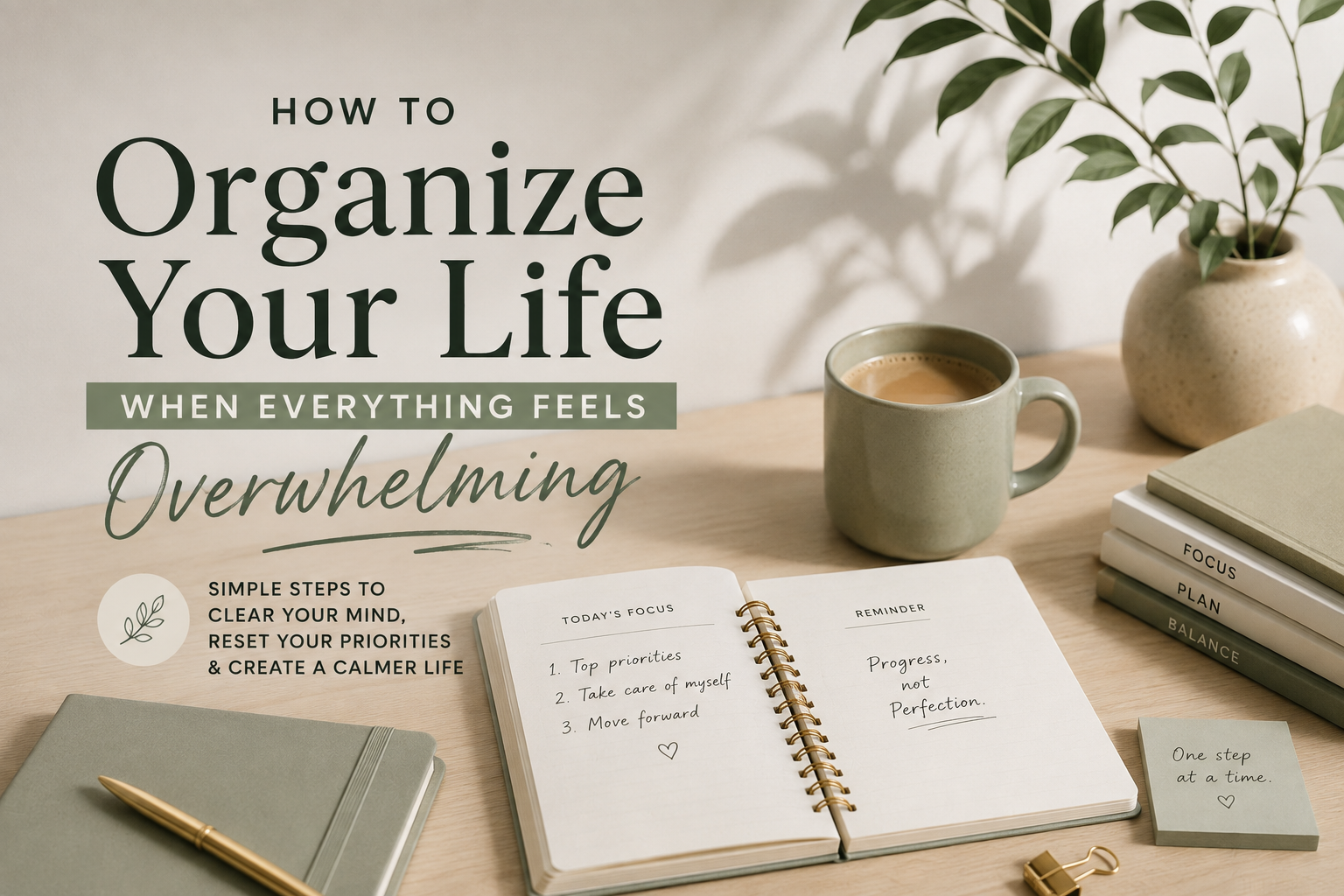
How to Organize Your Life When Everything Feels Overwhelming
When everything feels like too much, your first instinct might be to fix everything at once.
Clean the house. Answer every message. Catch up on work. Start exercising again. Fix your sleep schedule. Plan your goals. Finally organize all those things you’ve been putting off.
But trying to organize your entire life in one day can leave you feeling even more overwhelmed.
A better approach is simpler:
Don’t organize everything. Organize what matters next.
If you’ve been wondering how to organize your life when overwhelmed, this guide will help you turn the chaos into a small, realistic system you can actually follow.
Why Does Life Feel So Overwhelming?
Feeling overwhelmed doesn’t necessarily mean you have too much to do.
Sometimes the problem is that too many things are competing for your attention at the same time.
Your mind may be trying to remember unfinished tasks, appointments, goals, worries, messages, responsibilities and decisions all at once.
Stress can also make it harder to concentrate and make decisions. The NHS lists difficulty concentrating, struggling to make decisions, constant worrying and feeling overwhelmed among possible mental symptoms of stress.
So when your life feels disorganized, adding another complicated productivity system may not be what you need.
You need somewhere simple to begin.
How to Organize Your Life When Overwhelmed: 8 Simple Steps
You don’t need to complete all eight steps today.
Start with the one that would create the most relief right now.
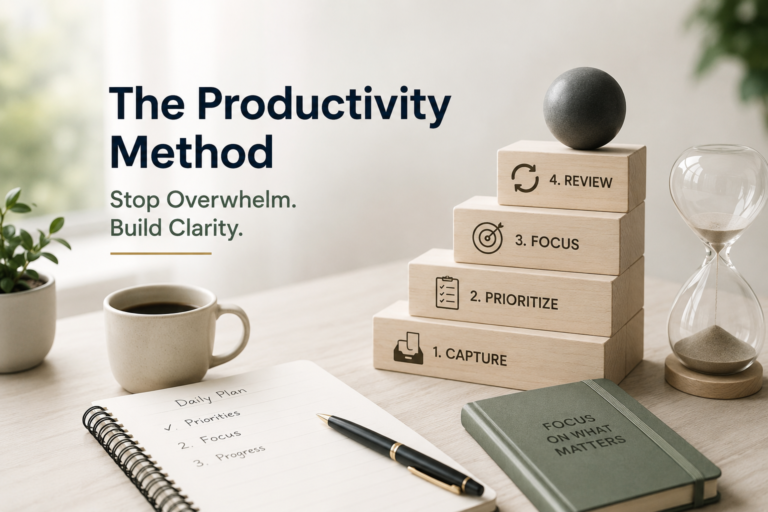
1. Get Everything Out of Your Head
Before organizing your calendar, room or routine, start by clearing some mental space.
Take a blank sheet of paper or open a note on your phone and write down everything that’s occupying your attention.
Don’t organize it yet.
Write down things like:
- Tasks you need to finish
- Appointments
- Things you need to buy
- Messages you need to answer
- Problems you’re thinking about
- Goals you’ve neglected
- Household tasks
- Ideas you don’t want to forget
- Decisions you need to make
Think of this as a mental inbox.
The goal isn’t to create another enormous to-do list. It’s simply to stop asking your brain to hold everything at once.
Writing worries down can make it easier to work through concerns individually rather than keeping everything circulating in your mind.
2. Separate What You Can Control From What You Can’t
Now look at what you wrote.
Ask yourself:
Can I actually do something about this?
Create two categories:
I can influence this
and
I can’t control this right now
This distinction matters.
If something can be changed, identify your next action.
If you can’t do anything about it right now, repeatedly thinking about it won’t organize it.
The NHS problem-solving guidance similarly recommends distinguishing problems with possible solutions from hypothetical worries that are outside your control.
Your energy is limited.
Spend more of it where action is possible.
3. Choose Your Top 3 Priorities
One reason traditional to-do lists become overwhelming is that everything appears equally important.
It isn’t.
Instead of asking:
“How can I finish everything?”
ask:
“What are the three things that matter most right now?”
For example:
- Pay an overdue bill.
- Finish an important work task.
- Prepare meals for the next two days.
That’s enough.
Your priorities can change tomorrow.
The goal isn’t to ignore everything else forever. You’re simply giving your attention somewhere specific to go.
4. Break Big Tasks Into Tiny Next Steps
Compare these two tasks:
Organize my house
and
Clear the clothes from my bedroom chair.
The first feels like a project.
The second feels like something you can start.
Whenever a task feels intimidating, keep making it smaller until the first action becomes obvious.
Instead of:
Get my finances together
try:
Open my banking app and check my balance.
Instead of:
Get healthy
try:
Prepare tomorrow’s breakfast.
Instead of:
Organize my computer
try:
Delete 10 files from my Downloads folder.
Breaking large tasks into manageable chunks is one of the practical strategies recommended by the NHS for reducing stress around tasks.
Small doesn’t mean insignificant.
Small means startable.
5. Create One Home for Your Tasks
If your responsibilities are scattered across sticky notes, screenshots, emails, notebooks and your memory, you’ll constantly feel like you’re forgetting something.
Choose one main place for tasks.
It could be:
- A paper planner
- A simple notebook
- Your phone’s reminders
- A calendar
- A digital task manager
You don’t need the perfect productivity app.
You need a system simple enough that you’ll actually check it.
Try keeping three basic sections:
Today
What genuinely needs your attention today?
This Week
What needs attention soon, but not today?
Later
What matters, but doesn’t require your attention yet?
Suddenly, 30 things don’t need to feel urgent at the same time.
6. Reset Your Physical Space — But Start Small
Your environment doesn’t need to look like a minimalist Pinterest board.
It just needs to work for you.
Choose one small area that affects your day most.
Maybe that’s:
your desk,
your bedside table,
your kitchen counter,
your backpack,
or your computer desktop.
Then use this simple reset:
Remove → Return → Reset
Remove what doesn’t belong.
Return items to where they belong.
Reset the space so it’s ready for its next use.
Then stop.
You don’t have to organize the entire house because you started cleaning one desk.
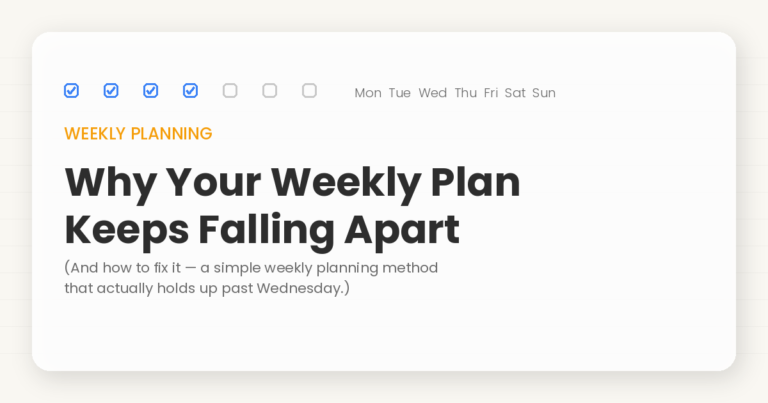
7. Build a Simple Weekly Reset
Getting organized once isn’t difficult.
Staying organized is the real challenge.
That’s why you need a reset instead of a perfect system.
Choose one time each week to spend around 15–30 minutes reviewing your life.
During your weekly reset:
- Check your calendar
- Review unfinished tasks
- Clear unnecessary reminders
- Choose next week’s priorities
- Prepare for important appointments
- Tidy your main workspace
- Review your habits
- Make time for something enjoyable
- Write down anything that’s occupying your mind
Don’t turn your weekly reset into another two-hour productivity project.
The purpose is to reduce friction for the coming week.
Balance matters too. NHS guidance on tackling a to-do list recommends making room not only for necessary and routine activities but also enjoyable ones.
8. Leave Empty Space in Your Life
This is the step many organization systems forget.
If every hour is scheduled and every day contains a long list of goals, even a perfectly organized life can become exhausting.
Don’t organize your life so tightly that there’s no room to live it.
Leave room for:
rest,
unexpected problems,
slow mornings,
friends,
hobbies,
thinking,
and doing absolutely nothing productive.
Organization should create space, not fill every available minute.
A Simple Organize Your Life Checklist
When everything starts feeling chaotic again, return to this checklist:
- Write down everything that’s on my mind
- Separate what I can and can’t control
- Choose my top three priorities
- Break overwhelming tasks into smaller actions
- Put tasks in one trusted place
- Reset one physical space
- Review my calendar
- Schedule necessary tasks
- Make room for something enjoyable
- Remove one unnecessary commitment
- Prepare for tomorrow
- Give myself some unscheduled time
You don’t have to check every box.
Sometimes completing the first three is enough to make the day feel more manageable.
What to Do When You Have Zero Motivation
Knowing what to do and feeling ready to do it are two different things.
On low-energy days, try the five-minute rule.
Choose one task and tell yourself:
I’ll do this for five minutes.
Then start a timer.
After five minutes, you can stop.
Starting with only five minutes can make an avoided activity feel more manageable, and the NHS includes this technique among its practical strategies for tackling tasks.
You might continue.
You might not.
Either way, you moved from thinking about the task to taking action.
What NOT to Do When You’re Feeling Overwhelmed
Avoid turning organization itself into another source of pressure.
You probably don’t need to:
- Buy a complicated planner system
- Wake up at 5 AM
- Completely redesign your routine
- Finish your entire to-do list
- Organize every room
- Start ten new habits
- Plan the next five years
Most importantly, don’t try to change everything at once.
Even NHS stress guidance recommends setting small, achievable targets rather than attempting everything simultaneously.
Your next step should feel almost boringly achievable.
That’s usually a good sign.
The 10-Minute Life Reset
Still don’t know where to begin?
Try this right now.
Minutes 1–3: Brain Dump
Write down everything occupying your attention.
Minutes 4–5: Choose
Circle the three things that matter most.
Minutes 6–8: Reset
Clean one small space around you.
Minutes 9–10: Plan
Choose the first task you’ll do when the timer ends.
That’s it.
You don’t need a complete life transformation tonight.
You need a clear next step.
How to Stay Organized Without Becoming Obsessed With Productivity
The purpose of organization isn’t to squeeze more work into your day.
It’s to make your life easier to navigate.
A useful system should help you know:
What matters?
What needs my attention now?
What can wait?
What can I let go of?
Regular check-ins can also help turn useful strategies into routines and make it easier to notice when something needs adjusting.
Your system can be simple.
In fact, simple systems are often easier to return to after life gets messy.
Create a Calmer System for Yourself
If your thoughts, habits, plans and worries all feel scattered, you don’t need to solve everything today.
Start with one page.
One priority.
One small action.
Then build from there.
If you’d like a structured place to work through your thoughts and routines, The Calm Within – Self Care Printable Bundle includes 52 worksheets, trackers and reflections covering breathing and calm, anxiety support, daily planning, goals, mindfulness, trackers and reflection. Your bundle itself includes tools such as a Daily Planner, Monthly Planner, Habit Tracker, Mood Tracker and weekly/monthly reflections.
Explore more printable tools in the MindStructur Shop.
For additional evidence-based guidance on dealing with stress and overwhelm, see NHS Every Mind Matters